 Rick
Rick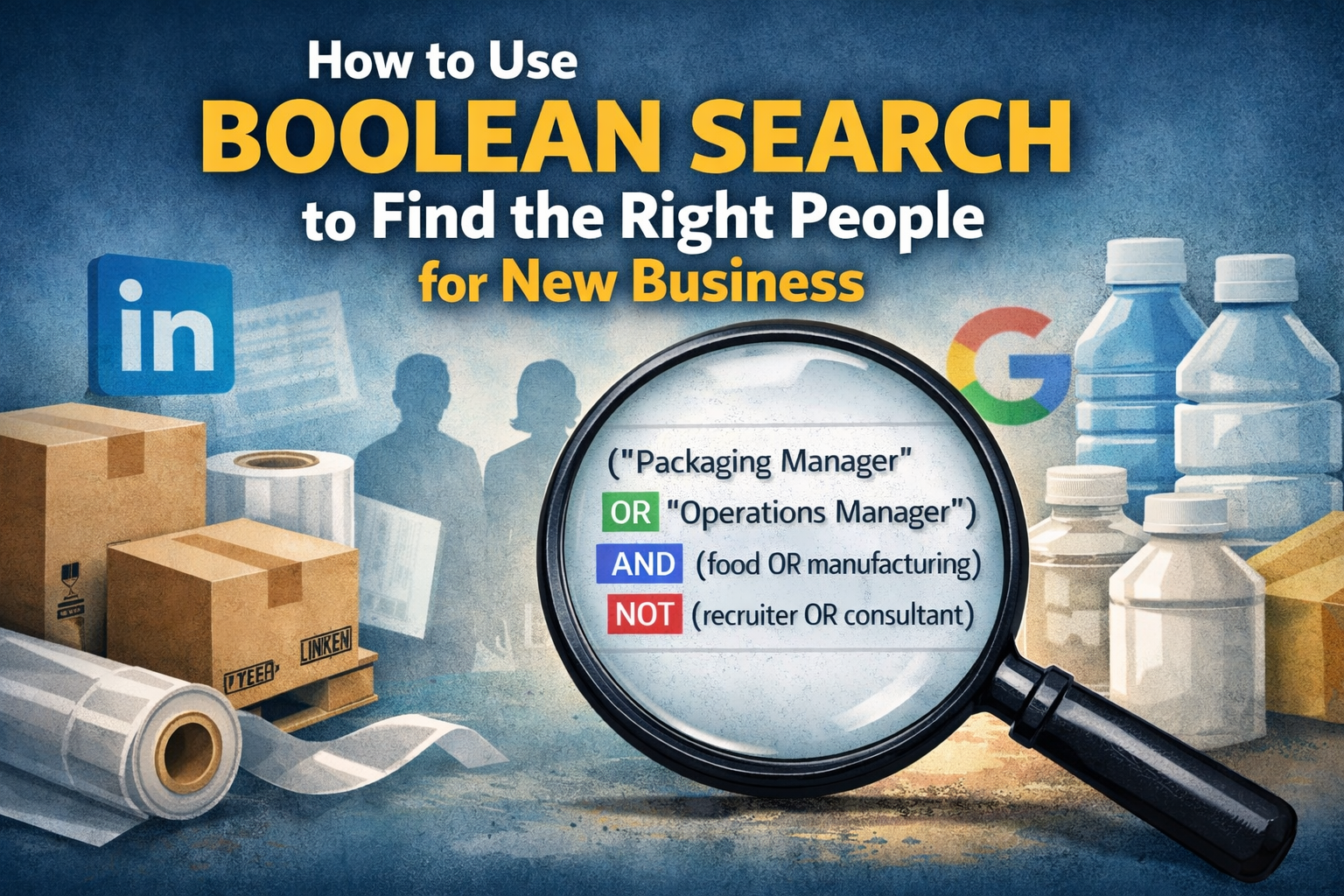
If you’ve ever spent a morning calling companies only to hear “that’s not my area”, “you need procurement”, or “I’m not involved in packaging”, this article is for you.
Most wasted sales effort doesn’t come from poor selling.
It comes from starting conversations with the wrong people.
Boolean search is one of the simplest tools you can learn to fix that. It’s not clever, it’s not technical, and it doesn’t require any special software. It’s just a way of telling search tools exactly what you’re looking for — and what you’re not.
I use it constantly when prospecting new accounts in packaging. Once you understand it, you’ll wonder how you ever searched without it.
The real problem with finding contacts
Most salespeople do one of three things:
- Search one job title (usually “Procurement Manager”)
- Rely entirely on a database
- Call a switchboard and hope for the best
None of those are terrible, but they’re inefficient.
The problem is that job titles are messy.
Two people doing the same job often have completely different titles. And two people with the same title can have wildly different levels of influence.
In packaging especially, the buyer is rarely just “procurement”.
You’ve got:
- People who specify materials
- People who care about line efficiency
- People who worry about sustainability and compliance
- People who sign contracts
- People who quietly block change
Boolean search helps you widen your net intelligently, without drowning in irrelevant results.
What Boolean search actually is (in plain English)
Boolean search is just a way of combining words using three simple operators:
- AND – both things must be present
- OR – either thing is acceptable
- NOT – exclude this
That’s it.
You’re already using this logic in everyday life.
If you said:
“I want a pub that serves food and allows dogs, not a chain”
You’re already thinking in Boolean terms.
Search engines, LinkedIn, CRMs and databases all understand this logic — you just have to speak their language.
Where Boolean search is useful for sales
You can use the same logic almost anywhere:
- Normal LinkedIn search
- Sales Navigator
This is the most common and most powerful use for salespeople.
Great for:
- Company websites
- Technical PDFs
- Job adverts
- “About us” and “Careers” pages
Google Boolean searches often surface contacts that databases miss.
CRMs and prospecting tools
Most allow Boolean logic in:
- Job title fields
- Notes
- Account searches
Once you learn the logic, the platform doesn’t really matter.
Stop thinking in job titles, start thinking in responsibilities
This is the most important part.
If you only search for job titles, you’ll always miss good contacts.
Instead, ask:
- Who is affected if packaging fails?
- Who specifies it?
- Who has to live with it day-to-day?
- Who cares about cost and performance?
In packaging, this usually leads you to clusters of roles, not single titles.
For example:
- Packaging Manager
- Operations Manager
- Technical Manager
- Production Manager
- Supply Chain Manager
- Sustainability Manager
Different companies call the same job different things.
Boolean search lets you capture all of them in one go.
The three building blocks of a good Boolean search
A strong Boolean search usually has three parts:
- Role group (who you want to speak to)
- Context (industry, product, or environment)
- Exclusions (who you don’t want)
Let’s go through them properly.
1. Building a role group (OR logic)
This is where most people go wrong by being too narrow.
Instead of searching:
Packaging Manager
You search:
("Packaging Manager" OR "Technical Manager" OR "Operations Manager")The brackets matter.
They tell the search engine to treat these as a group.You’re saying:
“Show me anyone with any of these titles.”
You can (and should) expand this over time as you see patterns.
2. Anchoring the search with context (AND logic)
Role titles alone can be vague.
Adding context makes your search far more relevant.
For example:
("Packaging Manager" OR "Technical Manager")
AND (food OR manufacturing)This filters out:
- Retail-only roles
- Agencies
- Unrelated industries
You can anchor context by:
- Industry (food, pharma, beverage)
- Product (cartons, trays, flexible packaging)
- Environment (manufacturing, production, factory)
3. Removing noise (NOT logic)
This is the most underrated part of Boolean search.
If you don’t exclude irrelevant roles, they’ll flood your results.
Common exclusions I use:
NOT (recruiter OR consultant OR sales OR marketing)Depending on the search, you might also exclude:
- Students
- Interns
- Freelancers
- Job seekers
Exclusions make your results cleaner and faster to review.
Putting it together: your first proper Boolean search
Here’s a simple, solid example for packaging sales into food manufacturing:
("Packaging Manager" OR "Technical Manager" OR "Operations Manager")
AND (food OR manufacturing)
NOT (recruiter OR consultant OR sales)This single search will usually surface:
- Specifiers
- Influencers
- Operational decision-makers
Not everyone will be the buyer — but they’ll be relevant.
That’s the goal.
Real packaging-specific examples
Below are examples you can adapt and reuse.
Food manufacturing
("Packaging Manager" OR "Technical Manager" OR "Production Manager")
AND (food OR poultry OR meat OR seafood)
NOT (recruiter OR consultant)Sustainability-led roles
("Sustainability Manager" OR "ESG Manager" OR "Packaging Technologist")
AND (packaging OR materials)
NOT (student OR intern)Supply chain and procurement (without consultants)
("Supply Chain Manager" OR "Procurement Manager")
AND (packaging OR cartons)
NOT ("procurement consultant")Each of these searches is intentionally simple.
Complexity doesn’t make them better — relevance does.
Common mistakes I see salespeople make
Searching only one job title
You’ll miss half the market.
Copying Boolean strings from the internet
Most are US-centric, outdated, or over-engineered.
Forgetting brackets
Without brackets, your search logic breaks.
Not excluding recruiters
Recruiters love packaging keywords. Exclude them early.
Trying to be too precise
Start broad, then refine. Don’t strangle the search too early.
Reviewing results before you reach out
Boolean search gets you closer.
It doesn’t replace common sense.Before contacting someone:
- Read their profile
- Look at their background
- Check what they post or comment on
Look for:
- Line responsibility
- Change projects
- Sustainability initiatives
- Machinery or process involvement
This helps you tailor your message so it doesn’t sound generic.
Turning search results into better conversations
The point of Boolean search isn’t volume.
It’s relevance.
When you speak to the right people, conversations feel different:
- Less defensiveness
- More practical questions
- Fewer internal hand-offs
You don’t need clever messaging.
You just need to sound like you understand their world.
Boolean search helps you get there.
Build your own reusable search library
Once you’ve got a few good searches, save them.
I recommend:
- One per sector
- One per buying role
- One per strategic focus (sustainability, cost reduction, automation)
Over time, you refine rather than start from scratch.
That’s how prospecting becomes calmer and more consistent.
Final thoughts
Boolean search isn’t a hack.
It’s not a growth trick.
It’s not a magic bullet.
It’s just a practical skill that helps you spend your time with the right people.
If you work in packaging sales and you’re building pipeline, it’s worth learning properly. The payoff isn’t more calls — it’s better ones.
And better conversations lead to better business.